
North Korea’s Hidden Remote Job Infiltration
North Korea’s Hidden Remote Job Infiltration
The Day the FBI Came Knocking
Imagine answering your door one day and the FBI is standing there with a warrant. They tell you your home is part of an international cybercrime ring run by North Korean IT workers. These operatives, sometimes called North Korean hackers in U.S. jobs, have quietly infiltrated American companies through remote work. They steal identities and send millions of dollars back to Kim Jong Un’s regime.
A Scheme Hidden in Plain Sight
Federal prosecutors say this is not a small-time hacking case. It is a sprawling operation that has been running for years. Trained North Korean IT workers pose as legitimate employees. They use stolen personal details and AI tools to land jobs they are not qualified for. The money they earn funds nuclear weapons, missile programs, and other state projects in North Korea.
A North Korean tech worker, often based in China or Russia, starts by obtaining a stolen American identity. This includes a Social Security number and work history. They build a résumé filled with fake experience. Sometimes they claim degrees from U.S. universities and jobs at well-known companies. They use AI to tweak a stock photo into a believable headshot.
When it is time for a job interview, AI tools generate live answers in English. The AI listens to the interviewer’s question and feeds the worker a response to read out loud. If there is a coding test or technical challenge, AI handles that too.
The Role of U.S. Middlemen
The biggest challenge for these workers is appearing to be in the United States. To solve this, they partner with an American middleman. This person receives the work laptop from the employer and sets it up in their home. They install software that allows the North Korean worker overseas to log in through it.
From the company’s perspective, it looks like the employee is working in Arizona or Illinois. In reality, they could be in an apartment in Liaoning, China. This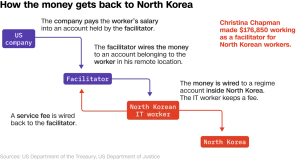 setup is called a laptop farm. Christina Chapman’s laptop farm was one of the largest ever found by the FBI. At one point she managed ninety laptops for over three hundred jobs. That brought in more than 17 million dollars for the regime.
The United Nations estimates North Korea’s IT worker program brings in between 250 and 600 million dollars a year. Some workers make 15,000 to 60,000 dollars a month. Every cent goes back to Pyongyang.
It is not just about money. Authorities warn these workers can plant malware, steal company data, and prepare for ransomware attacks. They have appeared in sensitive places such as a Nike contractor, a campaign website for an Oregon legislator, and major U.S. tech firms.
Expanding Beyond Tech
Investigators say the workers are branching out into other industries. These include architectural design, HVAC, and home remodeling. They pose as licensed engineers and offer to draft building plans online. One California restaurant even rebuilt its outdoor patio using plans traced back to a North Korean operative.
Small jobs may seem harmless. But when repeated thousands of times, they add up to major income for the regime.
Chapman’s role began in 2020. She was struggling financially and posting about it on TikTok. Someone reached out asking if she would “be the U.S. face” for a company and help remote IT workers get jobs.
She started falsifying documents, handling payroll, and shipping laptops overseas. Her lifestyle changed fast. She moved into a larger home, traveled internationally, and spent freely while claiming she ran a “computer business.”
In 2023, the FBI raided her home. Agents found rows of labeled laptops and detailed notes linking each one to a stolen identity. Prosecutors say she knew she was breaking the law, even if she claimed she did not know the workers were North Korean.
She pleaded guilty to conspiracy to commit wire fraud, aggravated identity theft, and money laundering. In July 2025, she was sentenced to eight and a half years in prison.
Just, WTF……..
Experts say the scheme is too large to fully shut down. North Korea has endless workers and willing U.S. facilitators. Recruiters are swamped with fake applications. Some are so convincing that they only fail when the applicant is asked a simple local question.
For everyday people, this is not about shadowy hackers in a dark room. It is about ordinary-looking job applicants who might be part of a foreign government’s money machine. It is about quiet suburban houses doubling as cybercrime hubs. And it is a sign of how easy it still is for dangerous actors to blend into America’s remote work culture.
If you thought a help wanted ad was harmless, this is proof that in the wrong hands even the most ordinary job can become a weapon.


You can't hack what you can't see.
Total invisibility, full control, zero noise.
Related Posts
Nuclear Access Through a Microsoft Hole
Nuclear Access Through a Microsoft Hole The agency that manages America’s nuclear weapons got breached…

Infostealer Malware Dump Exposes Billions of Logins
Infostealer Malware Dump Exposes Billions of Logins A massive data leak has just surfaced online,…

Massive Data Leak Exposes 184 Million Passwords from Major Platforms and Government Accounts
Massive Data Leak Exposes 184 Million Passwords from Major Platforms and Government Accounts A massive…

Texas-Based eWorldTrade and Pakistani Partner Abtach Exposed: Massive Scam Network Used Online Ads to Defraud U.S. Consumers
Pakistani Firm Shipped Fentanyl Analogs to US Using Scam Online Ads A Texas firm recently…

AI Voice Cloning Scams: The Threat You Can’t Ignore
AI Voice Cloning Scams: The Threat You Can’t Ignore Voice cloning scams are becoming a…
Trump Signs Executive Order to Boost AI Education in Schools
The Trump Administration’s Push for AI Education: A Huge Step Forward for America On April…