
Veteran Cyber Forensics Expert Under FBI Scrutiny After Credentials Fall Apart
Veteran Cyber Forensics Expert Under FBI Scrutiny After Credentials Fall Apart
A high-profile digital forensics expert who built a 30-year career testifying in over 2,000 court cases is now the subject of an FBI investigation. Mark Lanterman, founder of Minneapolis-based Computer Forensic Services (CFS), is being accused of lying under oath about his educational background and employment history. The fallout could shake up dozens of active and previously adjudicated cases across the country.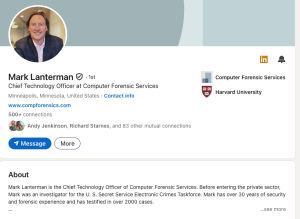
Lanterman, a former investigator with the U.S. Secret Service’s Electronic Crimes Task Force, has long been positioned as a trusted expert in matters ranging from data breaches and trade secret theft to white-collar crime and workplace disputes. Until recently, his biography boasted degrees in computer science from the now-defunct Upsala College and “postgraduate work” at Harvard.
But a deeper look suggests that may never have been true. Earlier this year, attorneys from Perkins Coie LLP—representing a client whose laptop had been reviewed by Lanterman—couldn’t verify any of his academic claims. When they contacted Felician University, the current custodian of Upsala’s records, no trace of Lanterman’s transcripts or graduation history could be found. He was also missing from all yearbooks and commencement records.
Even Lanterman himself now admits he can’t prove he ever attended the college. As for Harvard, what he called postgraduate studies turned out to be an eight-week online course via HarvardX, which explicitly warns it isn’t equivalent to a Harvard degree or certificate.
In March, the Hennepin County Attorney’s Office notified courts of ten pending cases involving Lanterman, noting that his credentials couldn’t be substantiated. Around the same time, Lanterman’s profile was scrubbed from the CFS website.
Sean Harrington, a rival forensics expert and attorney from Wisconsin, sparked the investigation. Harrington has accused Lanterman of repeatedly lying in court and exaggerating his qualifications. He also alleges Lanterman improperly disclosed confidential documents during a conference talk, claiming they came from a client who declined to hire CFS.
According to court filings, Lanterman’s resume omitted key details—such as his early work as a police officer in Springfield Township, Pennsylvania. When asked for proof, he allegedly visited the department under false pretenses and left with his own personnel file, never returning it.
Perkins Coie called the move “spoliation” and demanded sanctions. Harrington further claims Lanterman’s public persona is built on tall tales: involvement in the Bernie Madoff case, Martha Stewart’s investigation, even Paul McCartney’s divorce. He’s said to train the “entire federal judiciary” and teach cybersecurity at the highest levels. But there’s no independent confirmation of any of it.
Lanterman is also facing claims from past clients who say his firm held their data hostage during billing disputes. In one 2014 case, a Minneapolis law firm alleges that CFS threatened to auction off confidential legal data after a fee disagreement. In another case from 2009, a manufacturing company says CFS sold its proprietary data after a billing conflict—violating confidentiality terms and raising serious ethical concerns.
Lanterman missed a court appearance last week in a key case where Perkins Coie is seeking to strike his testimony. Instead, he sent a message withdrawing from the case, citing health issues and an intention to hand his business over to his children.
But according to an affidavit filed by his son, the decision wasn’t entirely voluntary. The family asked him to step down after intense media coverage and growing legal pressure. Former federal prosecutor Mark Rasch says the implications are massive.
“If an expert is discredited, any defendant convicted based on that expert’s testimony could have grounds to reopen their case,” Rasch said. “Attorneys have a responsibility to vet their witnesses thoroughly. That includes checking every credential and reviewing their track record in court.”
One major case now under the spotlight is the 2018 conviction of Stephen Allwine, found guilty of killing his wife after attempting to hire a hitman on the dark web. Lanterman’s forensic testimony was central to the prosecution. Allwine, who maintains his innocence, has filed a new petition to challenge the conviction in light of the recent revelations.
The legal system relies on trust, and when that trust is built on shaky claims, consequences follow.
Protect Yourself Before It’s Too Late
FATAL’s mission is to keep you ahead of the threats—digital and human. Start locking down your personal cybersecurity now: fvtal.com/start
Related Posts
North Korea’s Hidden Remote Job Infiltration
North Korea’s Hidden Remote Job Infiltration The Day the FBI Came Knocking Imagine answering your…

Nuclear Access Through a Microsoft Hole
Nuclear Access Through a Microsoft Hole The agency that manages America’s nuclear weapons got breached…
Infostealer Malware Dump Exposes Billions of Logins
Infostealer Malware Dump Exposes Billions of Logins A massive data leak has just surfaced online,…

Massive Data Leak Exposes 184 Million Passwords from Major Platforms and Government Accounts
Massive Data Leak Exposes 184 Million Passwords from Major Platforms and Government Accounts A massive…
Texas-Based eWorldTrade and Pakistani Partner Abtach Exposed: Massive Scam Network Used Online Ads to Defraud U.S. Consumers
Pakistani Firm Shipped Fentanyl Analogs to US Using Scam Online Ads A Texas firm recently…

AI Voice Cloning Scams: The Threat You Can’t Ignore
AI Voice Cloning Scams: The Threat You Can’t Ignore Voice cloning scams are becoming a…